Enhancing Athletic Performance with Senaptec Sensory Station
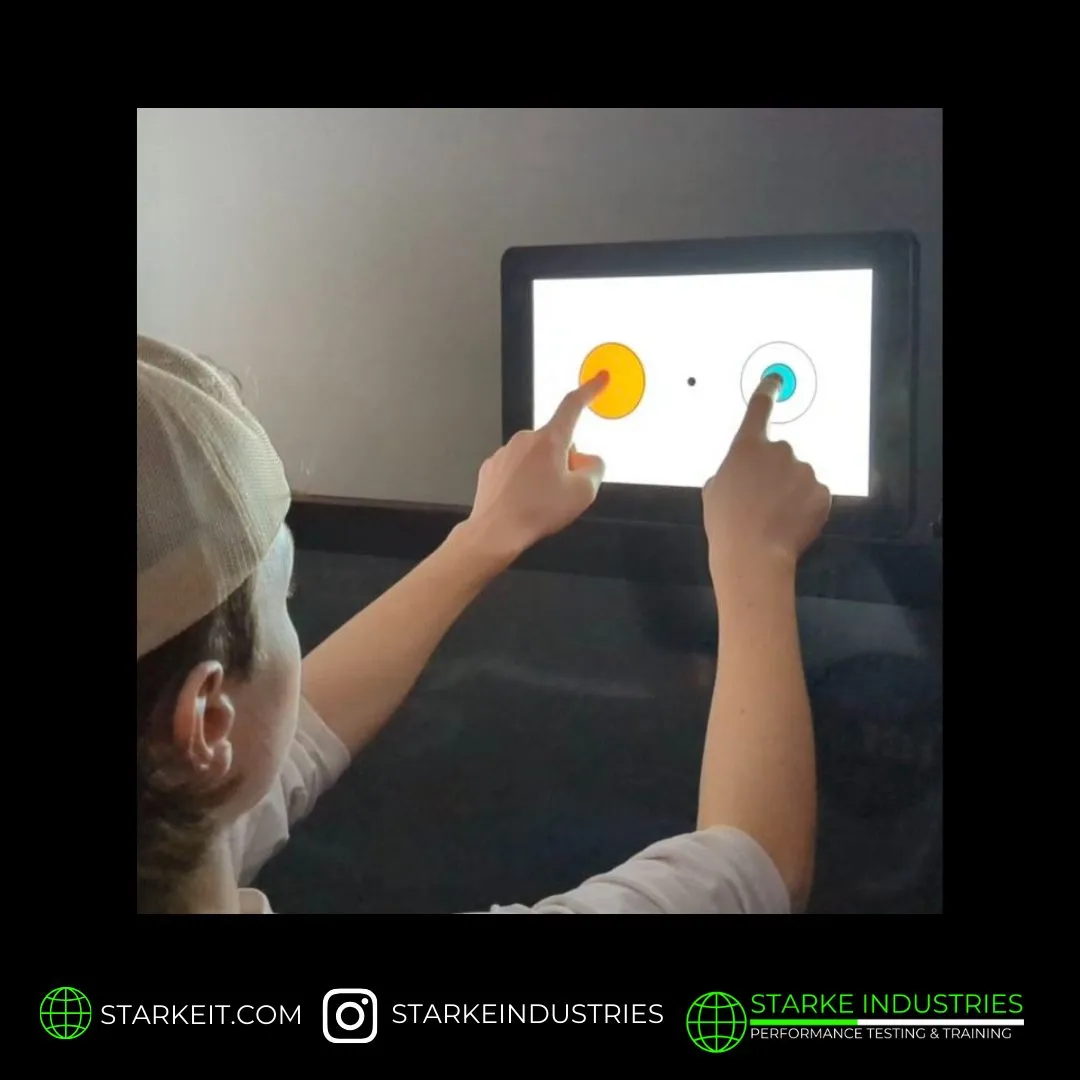
Answer first: The Senaptec Sensory Station assesses visual and sensorimotor skills—such as reaction time, depth sensitivity, and multiple-object tracking—and pairs results with training modules, optional tablet/app work, and Strobe eyewear. At Starke Industries it is used as a performance monitoring and training tool. Senaptec states the station is not intended to diagnose or treat medical conditions.
What the Sensory Station evaluates
Manufacturer materials describe a short evaluation (under about 25 minutes) covering visual, processing, and reaction skills. Named parameters include contrast sensitivity, near–far quickness, target capture, depth sensitivity, perception span, multiple object tracking, reaction time, peripheral reaction, and go/no-go. Starke Industries’ sensory pages describe a related set of key skills used in facility sessions.
Results are typically profiles or percentiles against a chosen comparison group. Read them as monitoring indicators—strengths and gaps versus a baseline—not as clinical diagnoses. See starkeit.com/sensory.
Training after the assessment
After the evaluation, the Sensory Station can assign modules from its training library. Senaptec describes automatic plan selection and cloud-stored progress across devices. Strobe glasses interrupt vision in a controlled way during drills so athletes practice under incomplete visual information. Portable tablet/app options extend practice away from the station. Progress is tracked by repeating the same assessments under similar conditions.
How to interpret scores
Compare an athlete to their own earlier Sensory Station runs first.
Peer percentiles are context only.
Cutoffs used to decide “train this skill next” are configurable program rules, not clinical norms.
Unexplained vision changes belong with an eye-care or medical professional.
Who it is for at Starke Industries
Athletes who want objective visual-motor baselines, teams that want position-relevant comparison data, and active adults who want to track reaction and tracking skills. Facility sessions are typically described in the 30–60 minute range depending on goals, with home app options for continued practice. Framing stays performance-focused: better measured sensorimotor scores over time—not claims about curing vision problems or predicting injury.
Fitting sensory work into the wider testing stack
Sensory scores sit beside force, metabolic, and recovery tools—not above them. A faster reaction-time score does not replace force-plate power data or metabolic testing. Use each monitoring indicator for the quality it actually measures, and keep the assess → train → re-test loop honest.
Sources
Key takeaways
Key takeaways: (1) Enhancing Athletic Performance with Senaptec Sensory Station covers monitoring indicators, not diagnosis. (2) Use assessment data to guide the next training block. (3) Re-test under the same protocol to see whether the plan worked. (4) Fill out our quick contact form at starkeit.com/contact, or call or text (847) 750-3025.
Related reading
VALD ForceDecks for program design · VALD Dynamo portable testing · PNOĒ metabolic testing · The power of breath
Fill out our quick contact form at starkeit.com/contact, or call or text (847) 750-3025. Starke Industries is in Palatine, IL.
Contact Starke Industries: 122 West Northwest Highway, Palatine IL 60067 · (847) 750-3025 · tyler@starkeit.com
About the author
Tyler Starke is the founder and performance coach at Starke Industries in Palatine, IL. Education (from his about page): Robert Morris University — Associate Degree — Exercise and Sports Studies; Robert Morris University — Bachelor's Degree — Allied Health Sciences. Selected credentials listed on starkeit.com/about: C.H.E.K. Holistic Lifestyle Coach — Level I & II; C.H.E.K. Integrated Movement Sciences — Level I, II, & III; Poliquin Group — Personal Training Certification; JSCP Strength & Power Science — Level I, II, & III; Fitness Business Institute — Certified Online Coaching Specialist; Online Trainer Academy — Certified Online Coach; PNOĒ Metabolic Analysis Foundations — Level I, II, & III; Dynamic Neuromuscular Stabilization — Exercise Part I; ArmCare Biomechanist; ArmCare Specialist; Altis Foundation.