Summer Off-Season Training for High School Athletes | Starke Industries
For most high school athletes, summer is the longest stretch of the year without games. It is also the stretch most often wasted. Some athletes stop training entirely for ten weeks. Others try to do everything at once, stacking camps, travel tournaments, and a new lifting program, then show up to fall practice tired instead of ready.
A better summer has a plan with three parts: recover, build, and check your work.
Part 1: Take a real break, but keep it short
After a long spring season, a short break from structured training is reasonable. Athletes need time for minor aches to settle and for motivation to come back. The question is how long that break can last before fitness starts slipping.
Research on detraining gives a useful frame. In a review of short-term detraining (less than four weeks of insufficient training), Mujika and Padilla described a rapid decline in maximal oxygen uptake and blood volume in highly trained athletes, while strength performance declines were limited over the same period [1]. In plain terms, aerobic fitness tends to fade faster than strength.
That suggests a practical approach: a lighter week or two is fine, but keep some conditioning in the mix, even if it's just pickup games, bike rides, or easy runs. Full shutdown for most of the summer means spending the first weeks of fall camp rebuilding what was lost.
Part 2: Build qualities that are hard to train in-season
In-season, practice and games take most of an athlete's time and energy. Summer is the window to develop the qualities that need consistent, progressive work:
• Strength. Squat, hinge, push, pull, and single-leg work, progressed over weeks.
• Power. Jumps, throws, and sprints, done fresh and with full intent.
• Mobility. Hips, ankles, and the thoracic spine, where restrictions can limit how an athlete moves.
• Aerobic base. Enough conditioning to recover between sprints and between practices.
The NSCA's position statement on long-term athletic development calls for a structured, logical, evidence-based approach, with youth athletes trained in an individualized, holistic, and child-centered way [2]. It also points out that young athletes who compete a lot without preparatory conditioning are often physically underprepared [2]. The International Olympic Committee's consensus statement on youth athletic development likewise sets out recommendations for developing healthy, resilient, capable young athletes [3]. Summer is when that preparatory conditioning fits best.
For a high school athlete, that usually means three or four structured sessions per week, built around the main lifts and jump and sprint work, with sport practice layered on top.
Part 3: Test at the start, re-test at the end
A summer program without testing is guesswork. You may feel stronger in August, but you won't know what changed, by how much, or whether the change is bigger than normal test-to-test variation.
A simple structure:
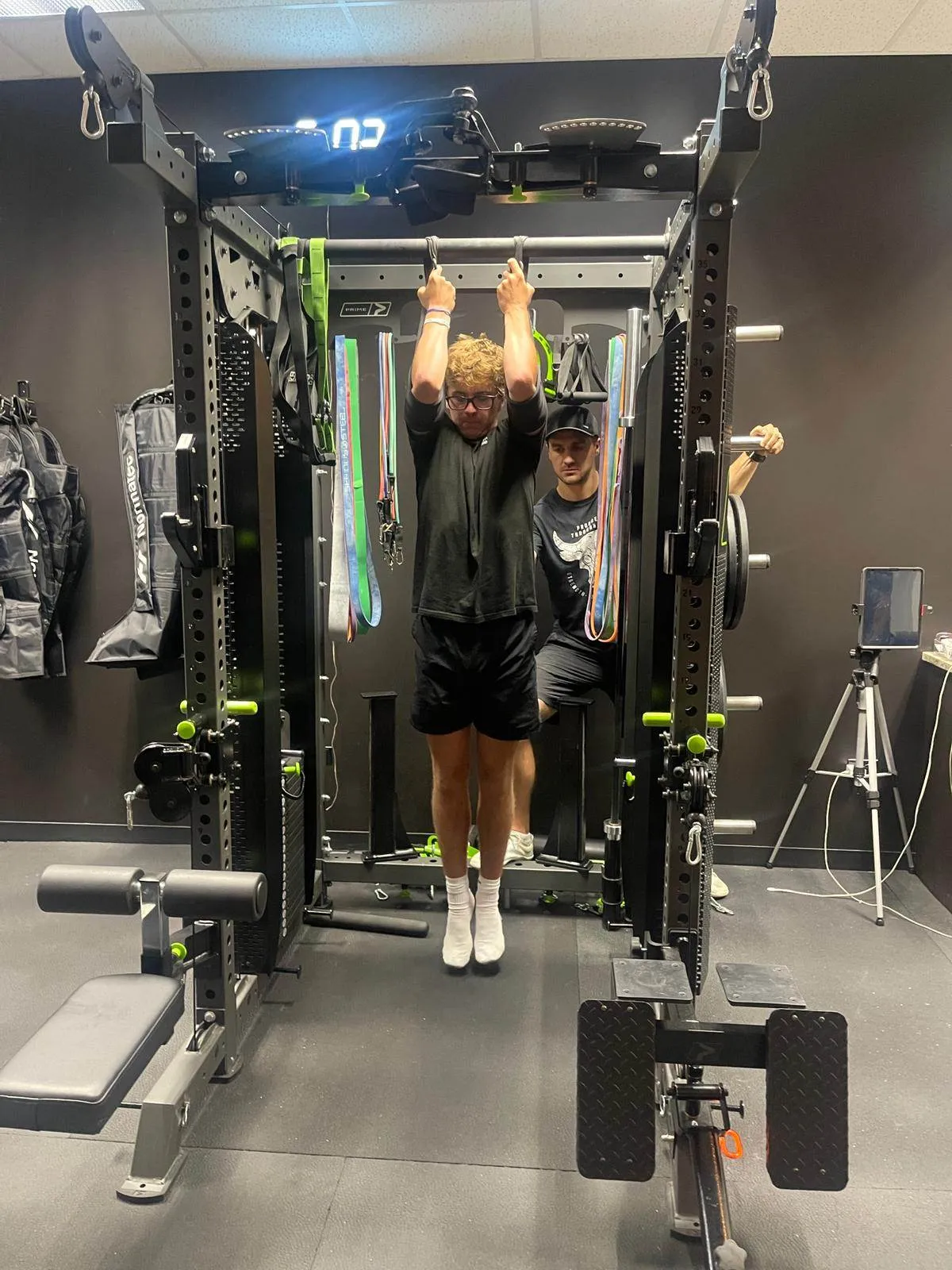
1. Week 1: Baseline test. At Starke Industries this typically includes force plate jump testing, mobility measures, and strength measures. 2. Weeks 2–7: Train with a program built around what the baseline showed. 3. Week 8 or later: Re-test with the same protocol, under the same conditions, at a similar time of day.
Re-test through the summer block so you can see whether training changed the numbers; keep the protocol identical both times.
Comparing two results only makes sense if the test was run the same way both times. Same warm-up, same instructions, same equipment.
What a summer training block can look like
A general example for a fall-sport athlete with roughly ten weeks of summer:
• Weeks 1–2: Active rest and baseline testing.
• Weeks 3–6: Strength emphasis, with jumps and sprints done early in sessions.
• Weeks 7–9: Power and speed emphasis, with conditioning ramping up toward preseason.
• Week 10: Re-test, reduce volume, and get ready for the first practice.
This isn't a prescription for every athlete. A wrestler cutting toward a fall goal, a soccer player with summer club commitments, and a lineman all need different plans. The point is the structure: rest on purpose, build on purpose, and measure.
Common summer mistakes
• Doing camps instead of training. Camps build skill and exposure. They rarely provide progressive strength and power work.
• Maxing out every week. Testing is not training. Frequent max attempts add fatigue without building much.
• Skipping conditioning until August. Ramping conditioning up suddenly right before preseason is a common pattern in youth sports.
• No re-test. Without a second test, there is no evidence the summer worked.
Questions parents ask
My athlete plays a summer travel sport. Can they still follow a program? Usually, yes, with fewer sessions. Two well-planned strength and power sessions a week, kept clear of tournament weekends, are far better than none. The program should account for game days rather than compete with them.
Should my athlete lift heavy over the summer? That depends on training age and technique, not the date on the wall. Load goes up when technique is consistent. A coach should be watching.
What if we only have six weeks? Shorten the plan, but keep the structure: a quick baseline, a focused block, and a re-test. Six weeks is enough time for measurable changes in many athletes, which is part of why Tyler recommends re-testing at about that interval.
The bottom line
A good summer comes down to a short break, a progressive plan, and a re-test that tells you whether it worked. Athletes who do that walk into fall with data instead of hope.
Related reading
- Baseline test
- Re-test
- Long-term athletic development
- Strength and power
- Hips, ankles, and thoracic spine
References
- Mujika I, Padilla S. Detraining: Loss of training-induced physiological and performance adaptations. Part I. Sports Med. 2000;30(2):79–87. https://doi.org/10.2165/00007256-200030020-00002 (published 2000)
- Lloyd RS, et al. National Strength and Conditioning Association position statement on long-term athletic development. J Strength Cond Res. 2016;30(6):1491–1509. https://doi.org/10.1519/JSC.0000000000001387 (published Jun 2016)
- Bergeron MF, et al. International Olympic Committee consensus statement on youth athletic development. Br J Sports Med. 2015;49(13):843–851. https://doi.org/10.1136/bjsports-2015-094962 (online Jun 17, 2015)
- ---
Fill out our quick contact form at starkeit.com/contact, or call or text (847) 750-3025. Starke Industries is in Palatine, IL.